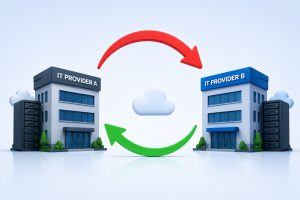
Most Toronto businesses start with break-fix IT. You call someone when something breaks, they fix it, you pay the bill. It feels simple. It feels cheaper. And for a long time, it works. Then it stops working. Which is why we thought it was important to explain the difference between Managed IT Services vs. Break-Fix IT Models.
This guide breaks down exactly what separates the two models, what each one actually costs in the Toronto market, and the specific point where break-fix becomes the more expensive choice.
Managed IT Services vs. Break-Fix IT: The Short Answer
Managed IT services provide continuous monitoring, maintenance, and support for a fixed monthly fee. Your provider manages your IT environment proactively, catching problems before they cause downtime. Break-fix IT services are reactive. You pay hourly only when something fails. For Toronto businesses with more than 10 employees, significant customer data, or any reliance on uptime, managed IT is almost always cheaper over a 12-month period when you account for the full cost of downtime, emergency rates, cybersecurity incidents and recurring issues.
Think of it like hiring an accountant. A two-person business might get by seeing their accountant once a year to file taxes. But a 10-person business that does not have a bookkeeper or accounting team managing their finances throughout the year is not saving money. They are accumulating risk, missing opportunities, and eventually paying far more to clean up what proper planning would have prevented.
IT works the same way. We do not make your technology generate more revenue. We make sure it never becomes the reason you lose it.
What Is Break-Fix IT Support?
Break-fix is exactly what it sounds like. Something breaks. You call a technician. They come and fix it. You pay for the time and parts.
There’s no ongoing relationship, no monitoring, no contract. The technician often has minimal context about your environment because they only show up when things go wrong. Once they leave, you’re on your own again until the next issue.
Break-fix IT services in Toronto typically costs $150 to $250 per hour. After-hours calls and emergencies usually sit at the top of that range or above it.
The appeal is obvious. You’re not paying a monthly fee for something that may not break. You feel in control of the spend.
What the hourly invoice doesn’t show you is everything else. The hours your team sat idle waiting for the technician. The work that didn’t get done. The client who couldn’t be reached. The repeat visit two weeks later because the root cause wasn’t addressed the first time.
What Are Managed IT Services?
A managed IT provider takes ongoing responsibility for your technology environment. They monitor your systems continuously, apply patches and updates on a regular schedule, handle help desk requests from your staff, manage your security tools, and respond to incidents when they occur.
You pay a flat monthly fee regardless of how many tickets are submitted or how many hours of work are done in a given month. The provider’s incentive is to keep things running smoothly because every problem they prevent is time they don’t have to spend fixing it.
Managed IT services in Toronto typically range from $100 to $175 per user per month for a comprehensive package covering help desk support, monitoring, endpoint security, patching, and backup management. Larger organizations or those with more complex environments or advanced security requirements may pay $175 to $250 per user.
For a 20-person Toronto business, that’s roughly $2,000 to $3,500 per month. For a detailed breakdown of what drives that number up or down, see our managed IT services pricing guide for Toronto businesses.
The Managed IT vs Break-Fix IT Cost Comparison for Toronto Businesses
This is where most break-fix vs. managed IT articles fall short. They compare the sticker price without running the real numbers. Here’s what that actually looks like for a 20-person Toronto company over 12 months.
Break-fix scenario:
A 20-person professional services firm averages two meaningful IT incidents per month. At $200 per hour with an average of 3 hours per incident, that’s $1,200 per month in direct IT spend, or $14,400 per year. That number sounds manageable.
But add the hidden costs:
- Each incident takes an average of 4 hours of employee time across the team waiting, workarounds, and recovery
- 20 employees at an average loaded cost of $50 per hour means $4,000 in lost productivity per incident
- Two incidents per month is $8,000 in productivity loss monthly, $96,000 annually
The break-fix bill is $14,400. The total cost of those incidents is over $110,000.
And that’s before a serious incident. A ransomware attack, a server failure during a critical deadline, or a data breach changes the math entirely. IBM’s 2025 Cost of a Data Breach Report puts the global average breach cost at $4.44 million. For a Canadian SMB, even a fraction of that number is catastrophic.
Managed IT scenario:
The same 20-person firm at $150 per user per month pays $3,000 monthly, $36,000 annually. Proactive monitoring catches most issues before they cause downtime. The incidents that do occur are resolved faster because the provider already knows the environment. Productivity loss drops significantly. The total cost of IT, direct and indirect, is a fraction of the break-fix scenario.
Businesses that switch from break-fix to managed IT typically cut IT-related costs by 25 to 45 percent. The monthly fee that looks expensive on paper is almost always cheaper than the reactive model it replaces.
When Break-Fix IT Still Makes Sense
This is the section most MSPs skip because they want to sell you managed services. Skipping it is a mistake, and it’s not honest.
Break-fix is a reasonable choice when:
- You have fewer than 8 to 10 employees
- Your technology use is minimal, mostly email, basic cloud applications, and a few laptops
- You don’t store customer data or handle sensitive information
- Your business can tolerate several hours of downtime without significant financial or reputational impact
- You have a capable internal person who handles most IT issues and only needs occasional specialist help
If all of those conditions are true, break-fix can work. A small retail operation with three staff using cloud point-of-sale software doesn’t need a managed IT contract. A 5-person accounting firm that handles client tax data absolutely does.
The problem is that most businesses that stay on break-fix have outgrown it. They’ve grown past 10 employees, added complexity to their tech stack, taken on client data they’re now legally obligated to protect, and they’re still operating on a model designed for simpler times. If you’re not sure where your business sits, our IT consulting team can help you map it out without any commitment.
When Managed IT Is the Clear Choice
The tipping point is usually one of these:
Your Team Relies on Technology to Work
If an outage stops your people from doing their jobs, you’re already paying for downtime. The question is whether you pay for it reactively or prevent it proactively.
You Handle Customer or Employee Data
Canada’s Personal Information Protection and Electronic Documents Act (PIPEDA) requires organizations that collect personal information to protect it and report breaches. Break-fix IT doesn’t provide the continuous monitoring, patch management, or documented security controls that regulators and insurers expect.
You’re Trying to Get or Renew Cyber Insurance
Insurers in 2026 require specific technical controls as a condition of coverage: multi-factor authentication on all accounts, endpoint detection and response on every device, tested and immutable backups, email filtering, and a documented incident response plan. A break-fix provider can’t deliver these things on an ongoing basis. They show up after the incident. That’s exactly when you need your coverage to hold, and exactly when insurers are looking for proof the controls were in place.
You’ve Had an Incident in the Past 18 Months
If you’ve dealt with ransomware, a phishing compromise, a server failure, or significant data loss, your environment almost certainly has underlying vulnerabilities that break-fix support didn’t find because it wasn’t looking. Xoomler’s emergency IT services are available for businesses that need immediate help before making a longer-term decision.
You’re Growing
Adding employees, opening new locations, or moving more of your operations into the cloud increases IT complexity faster than most business owners expect. Break-fix doesn’t scale. Every new system is another potential failure point with no one watching it.
To see what a well-run managed IT service actually delivers read: The Benefits of Managed IT Services: 10 Advantages for Growing Businesses
The Compliance and Cyber Insurance Factor
This angle rarely appears in break-fix vs. managed IT comparisons. It should, because for many Toronto businesses it’s the deciding factor.
Under PIPEDA, every Canadian business that collects personal information (customer names, payment details, employee records, health information) is required to have reasonable safeguards in place and to report qualifying breaches to the Office of the Privacy Commissioner within 72 hours.
“Reasonable safeguards” isn’t defined explicitly in the legislation, but insurers and regulators have made it increasingly clear what they expect to see: MFA, EDR, tested backups, documented policies, patch management, and a response plan. Break-fix IT delivers none of these on a continuous basis.
Cyber insurance underwriters in Canada now verify controls during the application and at renewal. According to Astra Security’s analysis of insurance data, 27% of denied cyber insurance claims were rejected not because of policy exclusions, but because the controls the business claimed to have in place weren’t actually there when the incident occurred.
An MSP provides the continuous implementation and documentation of those controls. A break-fix provider cannot. For businesses that need help aligning their IT environment with insurer requirements, Xoomler’s cybersecurity services include compliance and insurance readiness support.
For businesses renewing cyber insurance this year, the gap between what insurers require and what break-fix IT delivers is often the reason premiums spike or coverage is declined entirely. The Canadian Centre for Cyber Security publishes baseline security controls for Canadian SMBs that align closely with what insurers now require.
Side-by-Side Comparison
| Factor | Break-Fix IT | Managed IT Services |
| Cost structure | $150 to $250/hour, per incident | $100 to $175/user/month, flat rate |
| Response model | Reactive, after failure | Proactive, before failure |
| Monitoring | None | 24/7 continuous |
| Security tools | On request only | Included and maintained |
| Patch management | When called | Automated and scheduled |
| PIPEDA compliance support | No | Yes |
| Cyber insurance readiness | No | Yes |
| Predictable monthly cost | No | Yes |
| Provider knows your environment | Minimally | Deeply |
| Right for businesses under 10 employees | Often | Sometimes |
| Right for businesses 10 plus employees | Rarely | Almost always |
How to Know If You’ve Outgrown Break-Fix IT
Answer these questions honestly:
- Has your business experienced IT downtime that cost you billable hours, missed deadlines, or client friction in the past 12 months?
- Do you store client data, payment information, health records, or employee files on any system?
- Are you required to carry cyber insurance, or are you considering it?
- Do you have staff working remotely or across multiple locations?
- Have you added new software, cloud services, or devices in the past year without a formal review?
- Does anyone in your business know what’s actually running on your network right now?
If you answered yes to two or more of those, break-fix IT is creating risk your business has probably already felt. The question isn’t whether to switch. It’s how soon. A cybersecurity audit can give you a clear read on your current exposure before you make any decision.
Making the Transition from Break-Fix to Managed IT
The process is less disruptive than most business owners expect.
A reputable managed IT provider will start with a full assessment of your current environment before taking over anything. They document what exists, identify what’s missing, and establish a baseline. From there, they deploy their monitoring and security tools and begin taking ownership of the environment systematically.
If you’re switching from another MSP rather than from pure break-fix, a good provider handles the communication and handoff so your team doesn’t experience a gap in support.
The first 30 days typically cover environment documentation, security tooling deployment, and introduction of your staff to the new support process. By day 60, your provider should have a clear picture of your environment and a roadmap of any remediation work needed.
If you’re exploring managed IT services in Toronto, Xoomler offers a free IT assessment that covers your current environment, security gaps, and a clear recommendation on the right service model for where your business is today.
Frequently Asked Questions
What is the difference between managed IT and break-fix IT?
Managed IT is a proactive model where your provider monitors and maintains your systems continuously for a monthly fee. Break-fix is reactive. You pay per incident when something fails. Managed IT prevents most problems before they cause downtime. Break-fix only addresses problems after they’ve already disrupted your business.
Is break-fix IT cheaper than managed services?
The hourly rate for break-fix IT in Toronto ($150 to $250/hour) appears cheaper than a monthly managed IT contract. But when you factor in the full cost of downtime, lost productivity, emergency rates, and repeat incidents, managed IT is almost always less expensive over 12 months for businesses with more than 10 employees or significant technology dependence.
How much does break-fix IT cost in Toronto?
Break-fix IT support in Toronto typically runs $150 to $250 per hour for standard business-hours work. After-hours and emergency calls often cost more. Project work such as server replacements, network upgrades, or migrations is billed separately at hourly rates regardless of the model you’re on.
When does break-fix IT make sense for a small business?
Break-fix is a reasonable choice for businesses with fewer than 8 to 10 employees, minimal technology dependence, no sensitive customer data, and a reasonable tolerance for occasional downtime. Once any of those conditions change, the risk profile of break-fix IT grows quickly.
Why are Toronto businesses switching from break-fix to managed IT?
The main drivers in 2026 are cybersecurity threats targeting Canadian SMBs, cyber insurance requirements that break-fix providers can’t satisfy, PIPEDA compliance obligations, and the growing cost of downtime as businesses rely more heavily on technology. Most businesses that switch do so after an incident that made the true cost of reactive IT visible.
Does managed IT include cybersecurity?
A reputable managed IT provider includes cybersecurity tools and management as part of the standard service. This typically includes endpoint detection and response, multi-factor authentication enforcement, email filtering, patch management, and backup monitoring. These are the same controls that cyber insurers require. A provider that separates cybersecurity into an expensive add-on is a red flag worth asking about directly.
Can I switch from break-fix to managed IT without disrupting my business?
Yes. A good provider manages the transition including any handoff from a previous provider. The assessment and onboarding process is designed to run in the background while your team keeps working. Most businesses complete the transition in 30 to 45 days with no meaningful disruption.
The Bottom Line
Break-fix IT made sense when businesses had simple setups, minimal data obligations, and IT problems that were genuinely infrequent. Most Toronto businesses have grown past all three of those conditions.
Managed IT services cost more per month than a break-fix bill in a quiet month. They cost less than a break-fix bill in a bad month. And they cost far less than what happens when a bad month turns into a serious incident. Read more about the benefits of managed IT services for a full picture of what the shift looks like in practice.
If you’re not sure which model your business actually needs, start with a conversation. Xoomler offers a free IT assessment for Toronto businesses that covers your current environment, your risk exposure, and an honest recommendation on the right level of support.